
Have you ever spent a small fortune on a birthday present, only to discover your child already sitting inside the cardboard box it came in, pretending it’s a rocket ship, a pirate boat, a castle or a secret hideout?
Children have an incredible ability to see possibilities where adults see ordinary objects.
What to Include in your DIY CRAFT BOX:
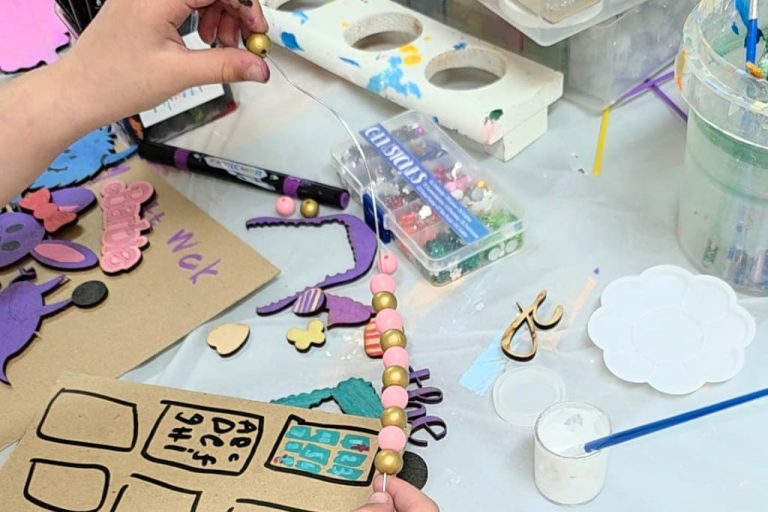
A simple craft box for kids might include paper, colouring pencils, paint, paintbrushes, glue, wooden shapes, pom-poms, gems, ribbon, stickers, wool and scraps of fabric. You can also add recycled and natural materials you already have at home, such as cardboard tubes, cereal boxes, leaves, twigs and shells.
When parents ask me what should go into a craft box, they are often expecting a shopping list.
How many paints do I need?
What craft supplies should I buy?
What activities can I make from it?
The answer usually surprises them.
Creating a simple craft box at home doesn’t require expensive supplies or a dedicated craft room.
You may already have most of what you need.
Basic Craft Supplies for Kids
A simple selection of basic craft supplies gives children plenty to experiment with. You might include:
- Paper and coloured card
- Child-safe glue
- Paint and paintbrushes
- Paint pens
- Colouring pencils or crayons
- Wooden craft shapes
- Pom-poms
- Gems
- Stickers
- A small selection of seasonal craft materials
You don’t need to include everything at once.
Use Everyday Household Items for Kids Crafts
The truth is, you may already have more materials in your home than you realise. There maybe everyday items that might otherwise be thrown away, recycled or forgotten at the back of a drawer.
Cotton wool can become clouds, snow, sheep or fluffy animal tails.
An old kitchen sponge can be cut into smaller pieces and used for printing patterns and textures.
Ribbon saved from gift wrapping or clothing tags can become bows, hair, hanging loops or decorative borders.
Buttons rescued from old clothes can find a second life as flowers, eyes, wheels or decorative details.
Scraps of fabric can be cut, glued, layered and transformed into all sorts of creations.
You can also save cardboard tubes, cereal boxes, packaging paper, old magazines, wrapping paper, stickers, lollipop sticks, paper plates, cupcake cases, old greeting cards, envelopes, wool, string and scraps of coloured paper.
Add Natural Materials to your Craft Box
Natural materials can be wonderful additions too. Leaves collected on a walk, small twigs from the garden, feathers, pine cones, conkers, shells from a beach trip or dried flowers can all find their way into creative projects.
Using everyday and natural materials doesn’t just make crafting more affordable.
it teaches children something valuable.
Creativity isn’t about having the newest supplies. It’s about looking at what is already around you and imagining what it could become.
The possibilities continue long after the first project is finished.
The Best Craft Box Isn’t the One with the Most Supplies
Give a child a box filled with hundreds of supplies and they can become overwhelmed before they even begin.
Give them a smaller selection of carefully chosen materials and something different happens.
They settle. They focus. They start creating.
One of the biggest misconceptions about crafting is that the finished item is the most important part.
It isn’t.
A few wooden shapes might become decorations, story characters, signs, gifts or part of an imaginary world.
The child doesn’t necessarily need us to decide what they’re making before they begin.
Sometimes the most valuable thing inside a craft box isn’t the paint, paper or glitter.
It’s the freedom to decide what happens next.
Make Craft Supplies Accessible to Encourage Independence
Another thing I noticed during my years working with children was that they were far more likely to engage in creative activities when the materials were accessible.
A child can decide, “I’d like to make something,” and within moments they are creating. Of course, the contents need to be safe and age-appropriate for the child using it.
I often compare it to children’s books.
We don’t usually keep children’s favourite books locked away until an adult decides it reading time. We leave them somewhere children can reach them, so they can choose them a book when they are interested.
Creative materials deserve the same consideration.
Having a simple, designated box means children begin to know where their materials are, what they can use and where everything belongs afterwards.
That small amount of ownership can make a big difference.
Rotate Craft Supplies Instead of Constantly Buying New Ones
Another thing I’ve learned over the years is that a craft box doesn’t need to contain every craft supply you own.
In fact, rotating materials can often make them more interesting.
When I worked in Montessori Education, we changed our themed activities monthly. I could practically tell when we’d reached the third week because interest would start to fade.
It was time for a change.
We’d swap the activities and materials around and when some of the original ones returned a few weeks later, they often felt exciting and new again.
You can use exactly the same principle at home.
Keep a core selection of basic craft supplies available and rotate some of the additional materials when you notice interest beginning to fade.
Sometimes you simply need to make something old feel new again.
Put Out Smaller Amounts of Glitter, Gems and Embellishments
If you’ve ever handed a child a full tub of glitter, you’ll know exactly what usually happens next!
A light sprinkle somehow becomes a glitter explosion.
The same can happen with gems, sequins, pom-poms and other exciting embellishments. Children are naturally enthusiastic and often use materials very generously.
Instead of placing full packets into the craft box, try putting smaller amounts into little containers, jars or trays and replenishing them when needed.
This helps craft supplies last longer, but there’s another benefit too.
Children begin making decisions about how they want to use what they have rather then simply using everything available at once.
And they rarely feel deprived by having less.
A tiny pot of glitter can feel just as exciting as a full packet.
The Craft Isn’t Finished Until Everything Is Put Away
Creativity and independence don’t have to end when the making stops.
One of the simplest ways to encourage independence is to include whay children need not only to create but also to tidy up afterwards.
That might mean a small cloth for wiping the table, a container for used paintbrushes, a little bin for scraps and a designated place where materials are returned.
Of course, it may not always be perfect.
But when everything has a place, children can gradually learn the whole process.
Choose. Create. Experiment. Tidy away.
They know where the paint goes, where the colouring pencils belong and where an unfinished project can be stored until another day.
Over time, the craft box becomes something they can take greater ownership of rather than an activity that always needs to be organised by an adult.
What if Your Child Doesn’t Know What to Make
Some Children will happily open a box of materials and immediately begin imaging what they could create.
Others benefit from having a little more structure to get them started.
That’s where a DIY wood craft kit can be useful.
It gives children a starting point without deciding everything for them.
A wooden craft can be painted, decorated with gems, covered with tissue paper, coloured with paint pens, embellished with ribbon or transformed into something completely different from its original design.
Our seasonal craft kits can also be added to an existing craft box throughout the year to introduce something new without having to replace everything that’s already there.
The aim isn’t to create something that looks exactly like the picture.
It’s to give children enough structure to begin and enough freedom to make it their own.
A Craft Box is About More Than Keeping Children Busy
Of course, there are practical benefits to having a craft box at home.
Some days it might provide twenty minutes of focused activity while dinner is cooking, you’re finishing a cup of tea or you simply want a few minutes of peace knowing they’re happily creating nearby.
Other days, those same materials might turn into an entire afternoon of creating, experimenting and storytelling.
But the real value goes beyond keeping children occupied.
A craft box gives them opportunities to choose, experiment, make mistakes, change their minds and ask: “What could I make with this?”
Let them find out.