
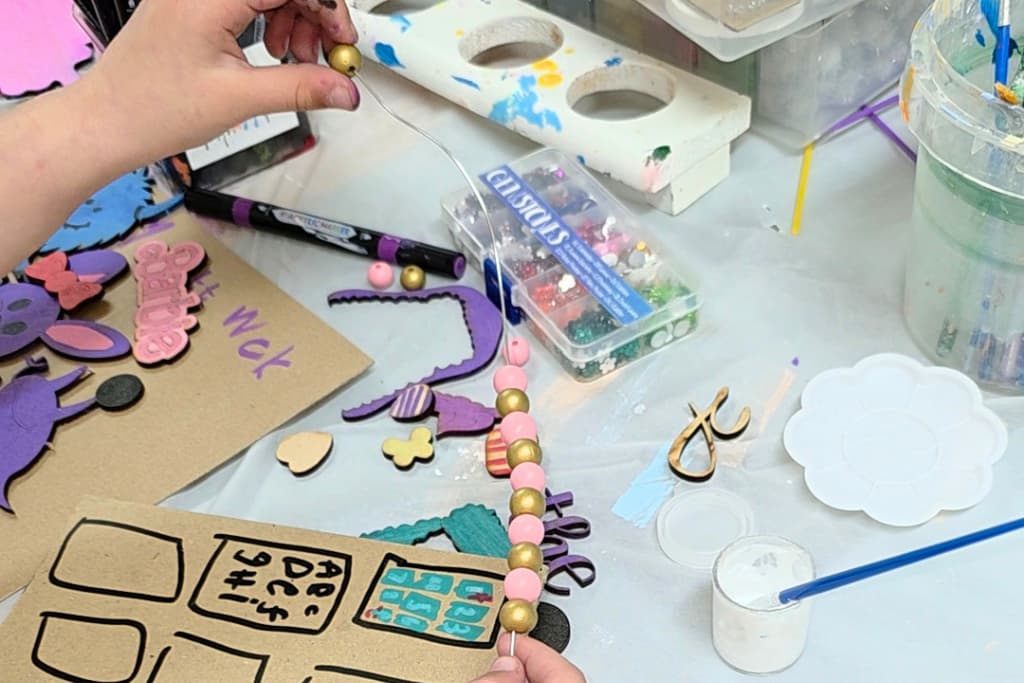
When people think about crafting, they often focus on the finished project. But what many don’t realise is that crafting is one of the most effective fine motor skills activities for children.
Every time a child paints, threads ribbon, sorts beads, squeezes glue or assembles a project, they are strengthening the small muscles in their hands and fingers while building confidence, independence, problem-solving skills and resilience.
The finished craft is wonderful, but the real learning often happens long before the paint dries.
When I was teaching in Montessori, I was probably guilty of telling parents that we practised fine motor skills to help children learn how to hold a pencil properly one day.
Not because it wasn’t true, but because it was the easiest way to explain it.
The reality is that fine motor development starts long before a child ever picks up a pencil.
From a very early age, children need opportunities to strengthen the small muscles in their hands and fingers.
When children pull on their own socks, fasten buttons, zip coats, feed themselves with a spoon or open a lunch box, they are doing far more than becoming independent.
They are building strength, control and coordination through real-life experiences.
Every time a child turns a door handle, grips a spoon or pulls on a sleeve, they are exercising the muscles in their hands and fingers.
In many ways, it is similar to an adult recovering from a hand injury who is advised to exercise those muscles to regain strength and movement.
The difference is that children are strengthening those muscles naturally through meaningful activities that have a purpose to them.
The more opportunities children have to use their hands, the stronger and more coordinated those little muscles become.
And if your child hasn’t had many opportunities yet, don’t worry. It is never too late to start.
Helping Without Taking Over
Modern family life is busy.
Parents are juggling work, school runs, activities, homework, meals, laundry and everything else that comes with raising children.
When there is a long list of things to do, it is often quicker and easier to step in and do something for a child rather than waiting for them to do it themselves.
We have all been there.
It is faster to zip the coat, tie the shoelaces, open the glue bottle or finish the task ourselves.
Sometimes that is exactly what needs to happen.
However, if we always step in, children lose valuable opportunities to practise.
Of course, giving children opportunities to do things for themselves does not always mean they will be happy about it.
Sometimes children become frustrated because a task genuinely feels difficult.
Other times, they simply don’t want to do it because they know an adult can do it faster or more easily.
That can be challenging for parents.
When a child is upset, frustrated or struggling, our natural instinct is to help.
But confidence and ability are built through practice.
If children have fewer opportunities to use their hands and complete tasks independently, those skills have less opportunity to develop.
The small muscles in their hands and fingers become stronger through use, just like any other muscle in the body.
The less children practise fastening buttons, opening containers, using scissors, squeezing glue bottles or manipulating small objects, the less opportunity those muscles have to strengthen and develop coordination.
This can sometimes create a cycle.
A task feels difficult, so the child avoids it.
Because they avoid it, they get less practice.
With less practice, the task continues to feel difficult.
The good news is that this cycle can be broken.
With encouragement, patience and opportunities to keep trying, children gradually discover that things which once felt impossible become easier.
The extra minute it takes today to let a child try, struggle a little and persevere often becomes the skill they can do independently tomorrow.
Children grow capable by being given opportunities to be capable.
Why Fine Motor Skills Matter
Fine motor skills are the small hand and finger movements we use every day.
- Holding a pencil.
- Buttoning a coat.
- Using scissors.
- Opening packaging.
- Tying shoelaces.
- Writing a shopping list.
For adults, these actions happen automatically because we have practised them thousands of times.
For children, their hands are still developing strength, coordination and control.
Their brains are building the connections needed to manage those movements smoothly.
The wonderful thing is that children do not need endless exercises to develop these skills.
They simply need opportunities to use their hands.
What Happens During Crafting?
At the beginning, it is just a bag of wooden pieces.
Nothing is painted.
Nothing is glued together.
Nothing looks like the finished picture yet.
Some children dive straight in.
Others spend a few moments examining the pieces, turning them over and working out how everything fits together.
Then the painting begins.
At first, the paintbrush can feel awkward.
Too much paint and it drips.
Too little and the wood shows through.
Sometimes a hand brushes against a piece that hasn’t dried yet.
But these moments are not problems.
In fact, they are often where the learning happens.
As a Montessori teacher for over 17 years and the owner of my own Montessori school, I spent years watching children learn through their hands.
What fascinated me most was how much learning was happening underneath the activity itself.
To an adult, it might look like a child is simply painting a wooden dinosaur or decorating a door hanger.
To the child, they are creating something special.
Underneath that, they are strengthening muscles, improving coordination, solving problems and developing confidence.
Most of the time, they do not even realise it.
Developing Fine Motor Skills Through Crafting
One of the things I love about crafting is that children use many different skills at the same time.
When children sort tiny mosaic pieces into colours, they think they are simply getting organised.
What they don’t realise is that every time they pick up a small piece between their thumb and finger, they are strengthening the same muscles they will later use for writing.
The same thing happens when children carefully place gems onto a project.
While they are busy decorating, they are also developing hand-eye coordination, precision and control.
Threading ribbon through a small hole can be surprisingly challenging for little hands.
The ribbon bends, twists and misses the hole completely.
Then eventually it works.
Moments like this help children develop patience, coordination and perseverance without anyone needing to create a lesson around it.
Many children spend several minutes sorting beads before they even begin using them. They compare colours, sizes and shapes while making creative decisions.
At the same time, they are strengthening finger muscles and developing the coordination needed to thread the beads successfully.
Even squeezing a glue bottle provides valuable practice.
At first, many children use too much glue.
Then they discover that a small amount often works better.
Through experience, they learn how much pressure to apply and how to control the movement of their hands.
One of my favourite things to watch is a child assembling the layers of a craft kit.
They turn pieces around, test different positions and compare shapes until they find the correct place.
What looks like a simple craft activity is helping develop spatial awareness, problem-solving skills and coordination.
Painting provides countless opportunities for learning.
Children quickly discover that wood and paint behave very differently.
The wood stays still while the paint moves.
Too much paint creates drips.
Too little leaves streaks.
Every brushstroke helps children refine control and strengthen the small muscles in their hands.
If children are using clay, they pinch, roll, squeeze and mould it into shape.
These simple actions are excellent for strengthening hand muscles and improving finger dexterity, yet to the child it simply feels like part of the fun.
What I’ve Seen Over The Years
As a former Montessori school owner and now running our craft parties, one of my favourite things to observe is the difference between the beginning and the end of a project.
At the beginning there is often hesitation.
“Can you do it for me?”
“I’m not good at painting.”
“What if I make a mistake?”
Then something changes.
Their movements become steadier.
Their confidence grows.
They start making decisions without asking.
They begin solving their own little problems.
And eventually, the same child who was unsure at the start is proudly holding up their finished creation and explaining exactly how they made it.
That confidence did not come from being told they were clever.
It came from doing something themselves.
And eventually, the same child who was unsure at the beginning is proudly holding up their finished creation and explaining exactly how they made it.
That confidence didn’t come from being told they were clever.
It came from doing something themselves.
More Than Just a Craft
When people look at a finished craft project, they usually see the decoration.
What I see is everything that happened before it.
The concentration.
The patience.
The problem solving.
The independence.
The persistence.
The confidence.
The strengthening of little hands preparing for all the things they will do in the years ahead.
Children learn all of these things while they are busy creating.
Most of the time, nobody needs to teach the lesson.
The experience teaches it for them.
A Final Thought
Think about a baby learning to walk.
We don’t expect them to stand up and run across the room on their first attempt.
We know there will be wobbles, tumbles and plenty of falls along the way.
Yet we don’t see those falls as failures.
We see them as part of the process.
The baby gets up and tries again.
Over and over.
Eventually those first shaky steps become confident running.
Crafting often works in much the same way.
The ribbon may not go through the hole on the first attempt.
The paint may drip.
The glue may end up somewhere it wasn’t supposed to.
A piece may be placed in the wrong position.
None of these things are failures.
They are opportunities to pause, think, adjust and try again.
Children develop resilience by experiencing challenges.
They develop perseverance by trying again.
They develop confidence by doing things for themselves.
And every time a child discovers, “I couldn’t do it before, but I can do it now,” they are building something far more valuable than a craft project.
They are building belief in themselves.
While the finished craft may eventually hang on a wall or sit proudly on a shelf, the skills developed while creating it will stay with them for years to come.
And that is one of the most wonderful things about crafting.
Ready to Get Started?
If you’re interested in how hands-on activities support children more broadly, you might also enjoy reading our blog about the benefits of crafting for children and how creative experiences help build confidence, independence and real-life skills.
A simple way to support these skills at home is through DIY craft kits. From painting and assembling to decorating and personalising, every project gives children the opportunity to strengthen their hands, solve problems and create something uniquely their own.
Explore our range of DIY craft kits designed to encourage creativity, independence and hands-on learning at home. Because sometimes what looks like a simple craft project is actually helping little hands prepare for much bigger things.
A Final Thought
When we watch a child painting, threading ribbon, sorting beads or carefully gluing pieces together, it is easy to focus on the finished project.
But the finished project is only part of the story.
What we are really helping children build are skills for life.
We are helping them become independent.
We are helping them become confident enough to try.
We are helping them learn that not everything works the first time, and that’s okay.
The ribbon might not go through the hole on the first attempt.
The paint might drip.
The glue might end up somewhere it wasn’t supposed to.
A piece might be put in the wrong place.
None of those things are failures.
They are opportunities to pause, think, adjust and try again.
As adults, we often rush in because we want to help. We want to save children from frustration. Yet some of the greatest learning happens in those moments when something doesn’t quite go to plan.
Because life won’t always go to plan.
At some stage, every child will face challenges, disappointments and things that feel difficult.
What matters is not whether everything works perfectly the first time.
What matters is learning that mistakes can be fixed, problems can be solved and difficult things become easier with practice.
One of my favourite sayings is:
“Success is not final, failure is not fatal: it is the courage to continue that counts.”
Every time a child picks themselves up after a mistake, tries a different approach or has another go, they are developing something far more important than fine motor skills.
They are developing resilience.
And that is a skill that will serve them long after the paint has dried and the craft project has been hung on the wall.
Think about a baby learning to walk.
We don’t expect them to stand up and take off across the room on their first attempt. We know there will be wobbles, tumbles, bumps and probably a few tears along the way.
Yet we don’t see those falls as failures.
We see them as part of the process.
The baby pulls themselves up, takes a step, falls down and tries again.
Over and over.
And eventually, without even realising it, they go from taking their first shaky steps to running around the garden.
Somewhere along the way, however, many children begin to lose that natural confidence to keep trying.
Not because they have become less capable, but often because the adults around them have become quicker to step in.
We help because we care.
We help because we want them to succeed.
We help because we don’t want them to feel frustrated.
But sometimes, in our efforts to make things easier, we accidentally take away the very experiences that help children develop confidence in their own abilities.
Children learn resilience by experiencing challenges.
They learn perseverance by trying again.
They learn confidence by doing things for themselves.
Of course, there are times when support is needed. The goal is never to leave a child struggling unnecessarily. Instead, it is about finding that balance between helping and allowing them the opportunity to work things out for themselves.
Because every time a child discovers, “I couldn’t do it before, but I can do it now,” they are building something far more valuable than a craft project.
They are building belief in themselves.